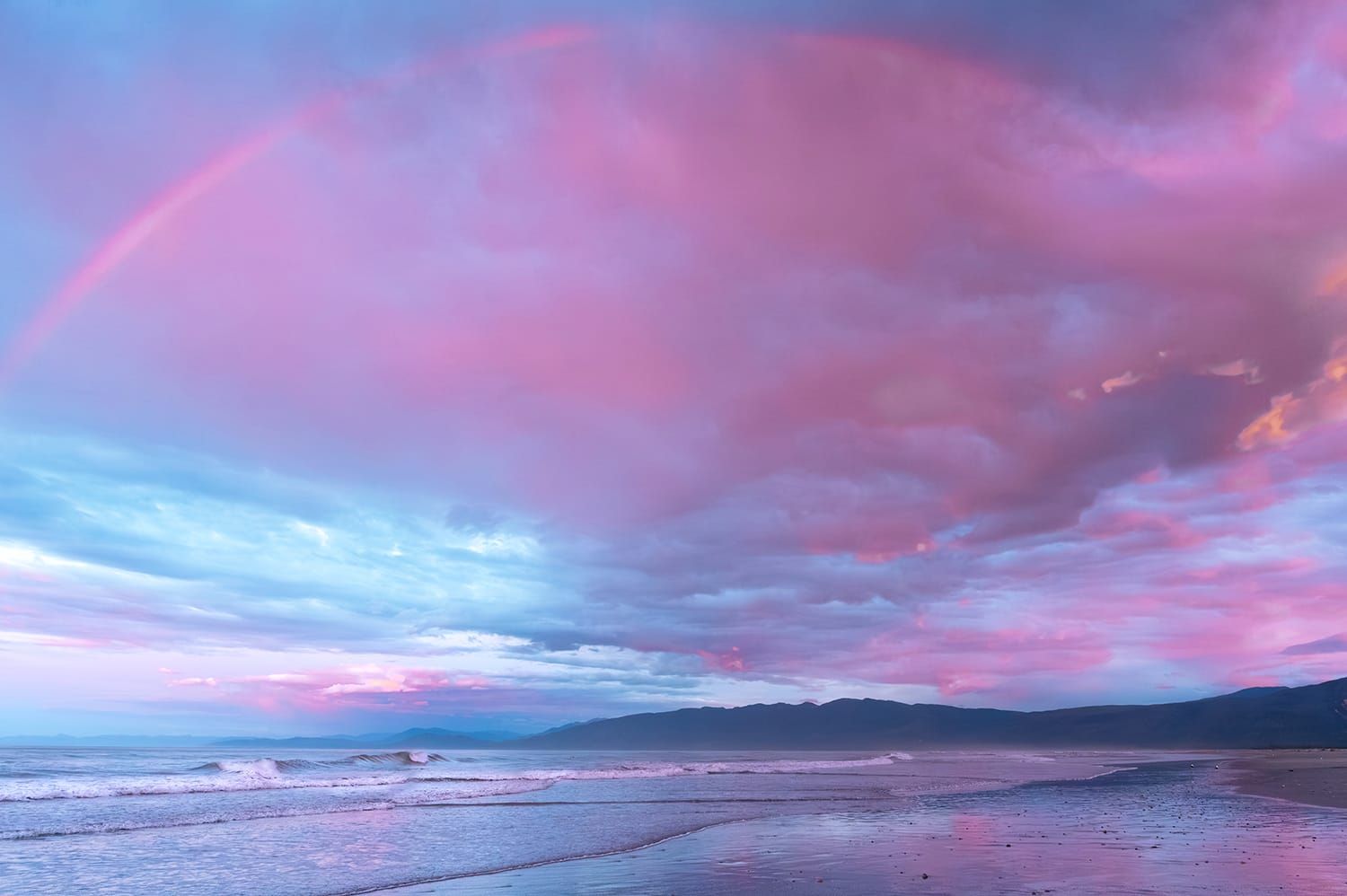
We’re standing on North Beach in Westport, marvelling at the summer sunset. A fireball in the sky in one direction. In the other, soft pastel pink and a full glowing rainbow, close enough that you swear you could run up the beach and be touched by it.
Brad’s got his back to it, mesmerised by the fireball in the other direction. I’m whistling and waving, trying to get his attention because any moment it can disappear.
He sees it and I breathe a sigh of relief.
The West Coast gets its reputation for rain. Weather rolls in from the Tasman, meets the mountains and delivers the sort of rainfall this part of the country is famous for. But what you may not know, is that most of the rainfall we get, is overnight, and the days are warm and sunny.
And the combination of rain and sunlight, gives us something else.
Rainbows. And we see a lot of them here. The West Coast is a rainbow machine.
There’s some rather lovely science behind all this. Sunlight enters a raindrop, bends, reflects inside it and bends again on its way out. The colours reach our eyes at particular angles, which is why a rainbow appears opposite the sun and why those late afternoon showers can be so good for spotting them.
A rainbow is also a circle. We usually see only the part that sits above the horizon, but get high enough, in an aircraft for example, with the right conditions, and it’s possible to see much more of it.
The other thing I love is that Brad and I, aren’t technically looking at exactly the same rainbow. A rainbow isn’t sitting in a fixed spot in the landscape like a mountain or a tree. What you see depends on where you are standing in relation to the sun and the raindrops. Move, and the geometry moves with you.
Which also explains why nobody has ever had much luck finding the end.
Every kid learns the colours. Red, orange, yellow, green, blue, indigo and violet. ROY G BIV.
Late in the day the colours can become warmer as the sunlight travels through more atmosphere. In very fine droplets, such as fog or mist, you can even get a fogbow, a pale, almost white cousin of the rainbow.
But mostly I like the ordinary ones. If you can call a huge band of colour appearing over the Tasman ordinary. There is something rather fitting about seeing so many rainbows on the West Coast.
We grew up with the same story as everyone else. Somewhere at the end there’s a pot of gold. Around here, that doesn’t feel entirely ridiculous.
People have been looking for gold on the Coast for a very long time. Rivers were worked by people who arrived believing there might be something valuable sitting beneath their feet.
So when a rainbow drops one end somewhere into the hills, or appears to land on a beach or riverbed, I can’t help thinking about it. Perhaps on the West Coast, of all places, you shouldn’t completely dismiss the old story. Wouldn't that be nice.
Back on North Beach, the light is changing again. The fireball has dropped lower towards the horizon and the rainbow behind us is already thinning. A few minutes ago it was so bright it looked close enough to touch. Now parts of it are disappearing altogether.
Then it’s gone.
Brad got the photograph.
Good thing I whistled.