Cape Foulwind's fifty years of hand-lit nights, and the names starting to surface from the record
There is a stretch of headland eleven kilometres west of Westport where the wind does not so much blow as arrive, all at once, from the Tasman, with nothing between it and you but grass and rock and the low shapes of seals hauled out on the point below. Captain Cook named the place in 1770, after his ship was thrown off course here. Foulwind. He meant it as a complaint. The people who came to live on that headland a century later might have agreed with him on the bad days, and there were plenty of those, but they built a life on it all the same.
The first light at Cape Foulwind was lit in 1876. The Customs Department's Marine Branch announced it that May, in a Notice to Mariners signed by Edward Richardson, warning shipping that a light would be exhibited from the new lighthouse "about the month of August next." The notice gives the kind of exact detail that survives from official records and rarely from personal ones: a revolving white light from a dioptric holophotal apparatus, flashing every half-minute, elevated 190 feet above high water and visible up to nineteen and a half nautical miles off in clear weather.
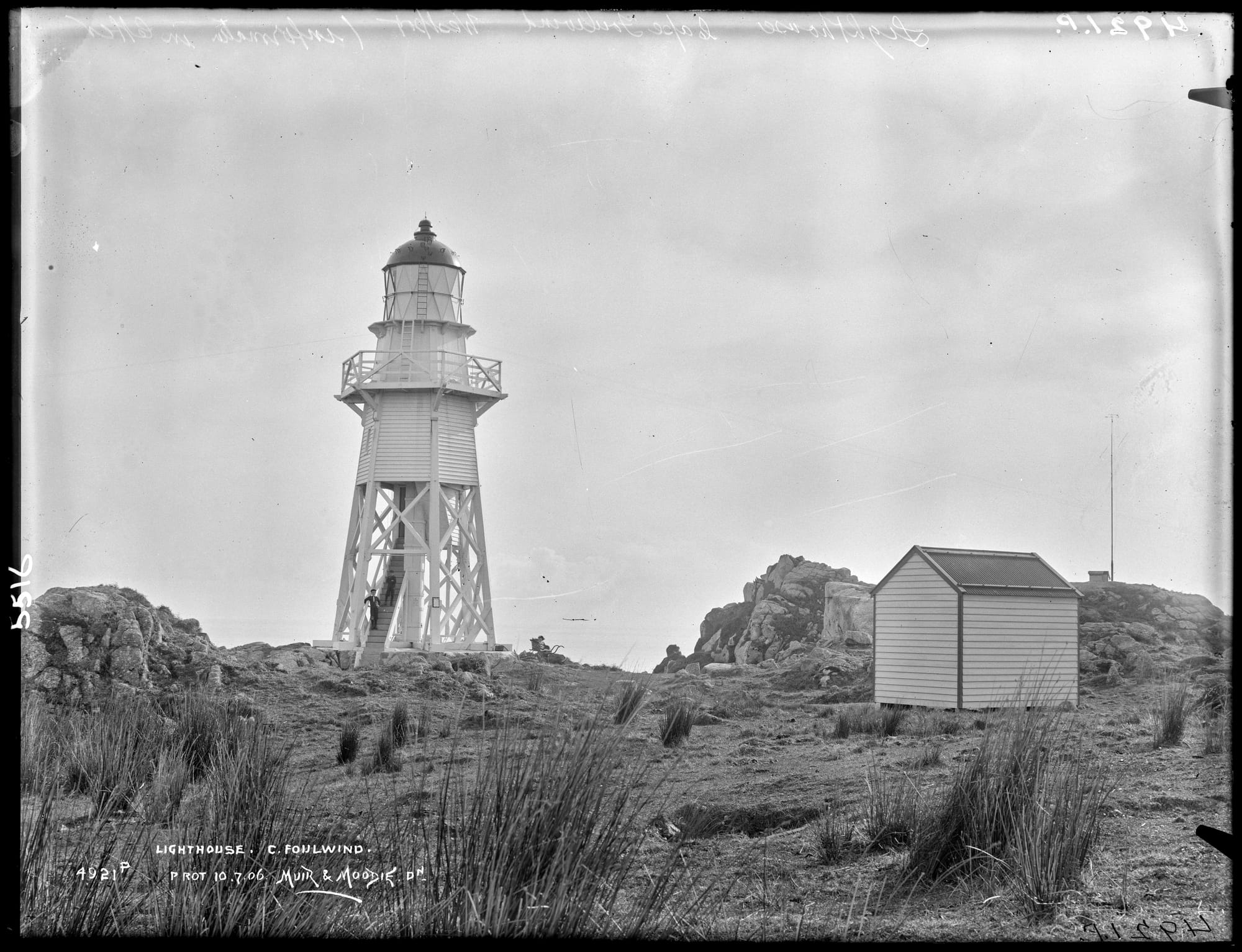
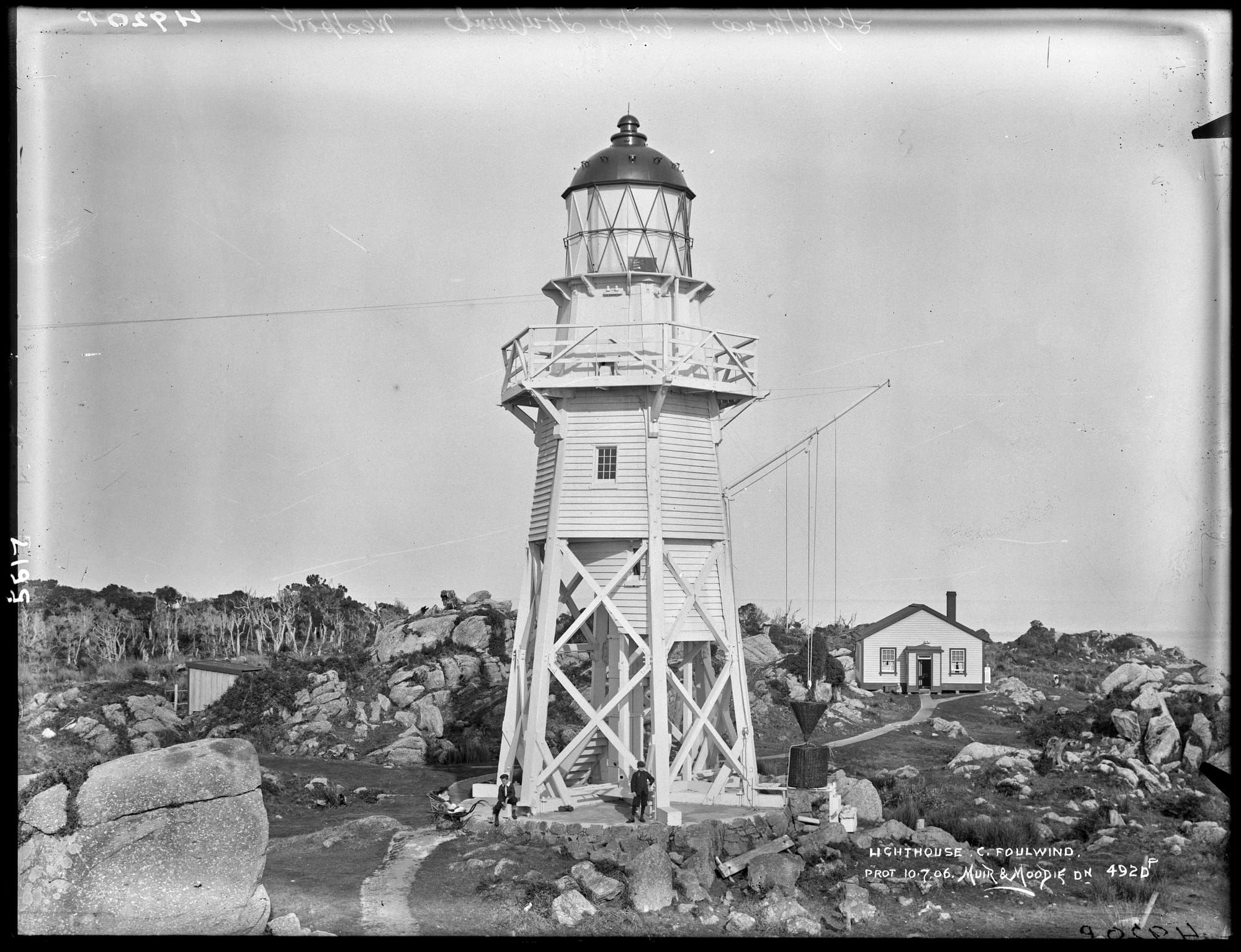
The tower itself stood 53 feet from base to lantern, hexagonal, built of timber, rimu according to later records, and painted white. Before it, ships working the coast during the gold rush years had only their own judgment and the shape of the land to steer by, and the Buller coast does not forgive bad judgment. The tower stood on the headland doing the one job it was built for: turning a light out to sea, night after night, so that someone further out could find their way past the rocks.
The first keeper was a man named Hand, and beyond his surname the record so far has given up nothing more. He was succeeded in 1881 by Fitzroy Montague Smith, whose tenure turned out to be short. In May 1882, not much more than a year into the job, the Westport Times reported that Smith had been ordered to hold himself ready to transfer to the Nuggets Lighthouse in Otago, to be replaced within three weeks by a keeper named Nelson, coming from Puysegur Point. The same short item is the closest thing to a personal portrait any of these records offers: it notes that the many summer visitors to Cape Foulwind would miss "the genial welcome always accorded them by Mr Smith," and offers him its congratulations on the promotion. Smith went on to hold several other lighthouse postings around the country before eventually settling in Westport, where he died at 63, and it is his death notice, decades later, that first put his name, and Hand's, into this story at all.
A lighthouse needs a keeper the way a fire needs someone to feed it. For fifty years, the Cape Foulwind light was tended by hand. The families who lived there kept the lamp fuelled and the lens clean and the mechanism wound, watch after watch, in weather that came off the Tasman with nothing to slow it down. Their houses stood beside the tower.
A touring correspondent who wrote up New Zealand's lighthouses for the Star in February 1894 found a keeper named Hansen already in charge, and noted that the station was not nearly as isolated as some of the others further south, which made it, in his words, "rather a favourite with keepers." Hansen stayed at least another three and a half years. In August 1897, the Marine Department transferred him out to Portland Island and brought in Richard Tregurtha from Pencarrow Head to take charge. Five months later, a single line in the Evening Post's marriage notices confirmed Tregurtha was still there: his son, Frederick Albert, married Edith Maud Boyd in Wellington on 22 December 1897, the notice describing his father simply as being "of Cape Foulwind Lighthouse." It is not much, but it is proof of an ordinary family life carried on at the station: children raised on that headland who grew up, left, and married, the way children do everywhere.
The Lighthouse Service kept its own records of these comings and goings, and a handful more survive in the newspapers of the day. The Press reported on 21 June 1898 that the service had transferred an assistant keeper named Partington from Cape Foulwind to become principal keeper at Mokohinau, off Auckland's coast, with an assistant keeper named Reeves brought in from Cape Saunders to take up the vacant post. Keepers were shifted around the country's lighthouses like this throughout the service's history, Cape Foulwind to Mokohinau, Cape Saunders to Cape Foulwind, a working life spent moving from one exposed headland to the next. In October 1902 a keeper named Thwaites arrived from Dog Island lighthouse to take charge, and by April 1904 a separate notice records a principal keeper named Fletcher resigning his post, with a keeper named Leighton transferred in from East Cape to take his place. It is not yet clear from the record how Thwaites, Fletcher and Leighton actually sequence, only that all three passed through.
Some of what the work asked of a person survives in a single, extraordinary account from a decade later. On the night of 4 September 1913, a storm built up from the west after sunset and was raging by midnight, forked lightning and heavy thunder rolling in off the Tasman. Just before one in the morning it broke in full force, and the principal keeper, Mr MacIvor, was up in the tower on duty when lightning struck the telephone wires outside his own dwelling. The current followed the wires straight into the house. It smashed the front door to pieces, tore the inner porch door from its hinges, broke a window and a fanlight, ruined a barograph, and set the wires alight along their whole run through the building. Mrs MacIvor was alone in the house at the time and put the fire out herself. The current kept travelling, along the telephone lines to the lighthouse and on to the assistant keeper's house, where it went to earth in a loud explosion that filled the room with smoke from scorched paintwork. Fifty yards away, at the signal house, the same strike ran down an iron flagstaff and split the floorboards to matchwood, bursting the walls open at every corner from floor to ceiling. Everyone in every building escaped without injury, which the correspondent who reported it seemed to consider close to a small miracle, and reading the account now, it is hard to disagree.
The rimu tower did not last much beyond that. Timber on an exposed headland rots, and by the 1920s the original structure had had enough. A new tower went up behind it, this one built of concrete, close enough to the old site that it still shares the same view out to the same stretch of sea. The light in the new tower was first lit in 1926, running on acetone, automatically, needing refuelling only twice a year instead of a keeper's nightly attention. It was efficient. It was reliable. And it made the keepers unnecessary. The last keeper left Cape Foulwind that same year, closing out fifty years of a particular kind of working life on that headland. In the 1950s the acetone system was converted to electricity, and today the light is monitored from an office in Wellington and still turns its beam out over the Tasman every twelve seconds, a small irony for a place that once depended entirely on someone standing watch in person, on the spot, in the weather.
What is left, if you walk the headland now, are the foundations. Two sets of them: the old tower's, and the keepers' houses beside it. Low stone and concrete outlines in the grass, the kind of thing you could walk straight past on your way to the seal colony further along the walkway, unless you already know what you are looking at. It is easy enough to stand there and picture the tower. It takes a little more to picture the people. The families who raised children on that headland, who kept a fire and a lamp and a household going in a place built almost entirely out of wind, who did work that mattered enormously to strangers on ships they would never meet, and who then, in 1926, packed up and left the job to a mechanism that needed no one.
One name carries the story furthest into living memory. Frank Dennehy, believed to have been the first white child born at Addison's Flat, served with the lighthouse service at Cape Foulwind before postings at Cape Maria van Diemen and Godley Head. He later farmed in the North Island, Canterbury and South Westland, and died at Barrytown in 1947, aged 80. His obituary in the Greymouth Evening Star names four sons and three daughters, two of the sons, Daniel and Joseph, still at Barrytown at the time of his death. It is the closest any of these records comes to a family still rooted in the district, and it is exactly the kind of thread we would like to follow further.
That is the part of the story we would like to keep from disappearing. Official records tell you when the light was lit, when the tower was rebuilt, when the last keeper walked off the headland for good. They do not tell you much about the people themselves, what the work felt like from the inside, what got passed down.
If the name Hand, Smith, Nelson, Hansen, Tregurtha, Partington, Reeves, Thwaites, Fletcher, Leighton, MacIvor or Dennehy means something to your family, or if you know of other keepers who served at Cape Foulwind before 1926, we would like to hear from you. Photographs, letters, stories passed down at the kitchen table: this is exactly the kind of material Sense & Wander exists to hold on to, before it is gone the way the rimu tower went.